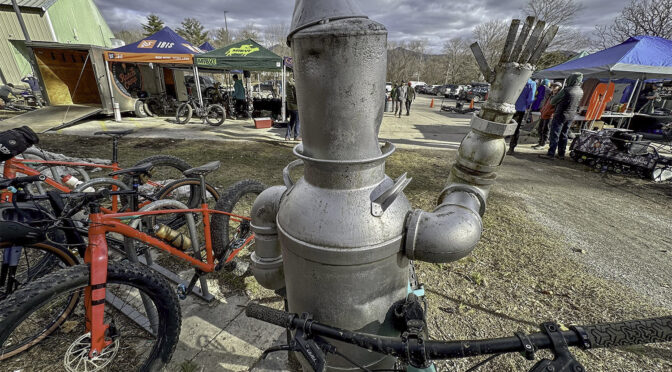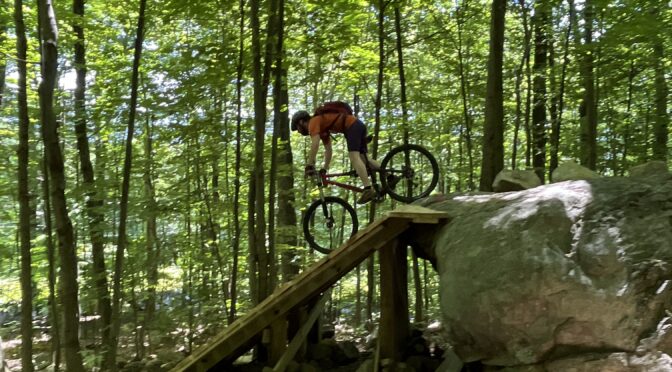
Volunteers along with KSA Built have put in two new features on Furlough.
Name this feature by sending pinehillpartnership@gmail.com an email with ‘name that feature’ in the subject line.
Winner gets a choice of Pine Hill Partnership t-shirt or hat.

Volunteers along with KSA Built have put in two new features on Furlough.
Name this feature by sending pinehillpartnership@gmail.com an email with ‘name that feature’ in the subject line.
Winner gets a choice of Pine Hill Partnership t-shirt or hat.
by Tom Estill
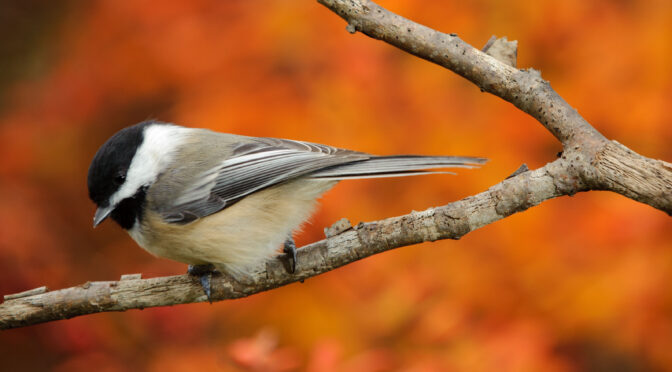
Near the first day of spring, 2024, a major snow storm came through the area and dumped about 18” of snow on the ground. On a late afternoon walk the forest was relatively quiet with just a few birds seen including, yellow-crowned kinglet, tufted titmouse, crow, black-capped
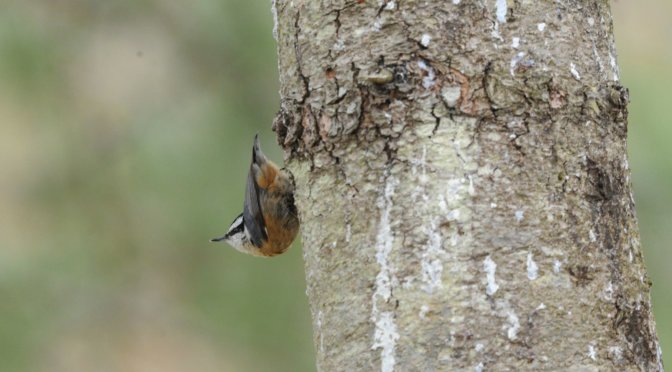
chickadee, white-breasted nuthatch, and a turkey vulture flying overhead. On March 26th, snow continued to melt, but it was still very deep. I was hoping to see some of the first migrants to arrive, but saw only tufted titmouse, pileated and downy woodpeckers, crown, white-breasted nuthatch and a red squirrel near the trailhead.
On a March 28th hike, snow was melting rapidly, with bare ground becoming a more and more common sight. A good day for birdwatching with a cardinal, mourning dove, Carolina wren, dark-eyed junco, tufted titmouse, black-capped chickadee, American goldfinch feeding on birch catkins, crow, golden-crowned kinglet, white-breasted nuthatch, ruffed grouse, and pileated woodpecker, all being seen.
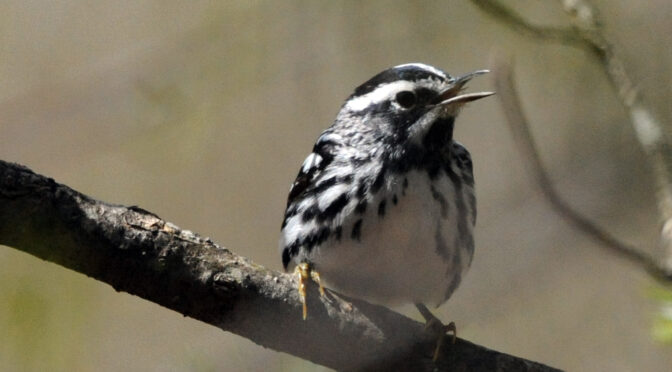
On March 30, the first wildflower of the season was seen flowering where it’s always seen-in the wetland areas adjacent to the boardwalk near the trailhead. That flower is, of course, COLTSFOOT. Also, on this day was seen the first migrating warbler, the black and white warbler. Dark-eyed juncos were chasing one another, establishing their territories, and a few Canada geese were sitting on their nests on the little islands on the west side of Muddy Pond.
Also, on the pond were a few pairs of mallards, and about a dozen common mergansers. It felt like an early spring day.
On the last day of March, a Cooper’s hawk was seen bringing nesting material to a nest it was building near the Lower Giorgetti trail, close to where last year’s Cooper’s Hawk nest was located, but which has since been abandoned. A second Cooper’s Hawk was seen perching near the nest they were building.
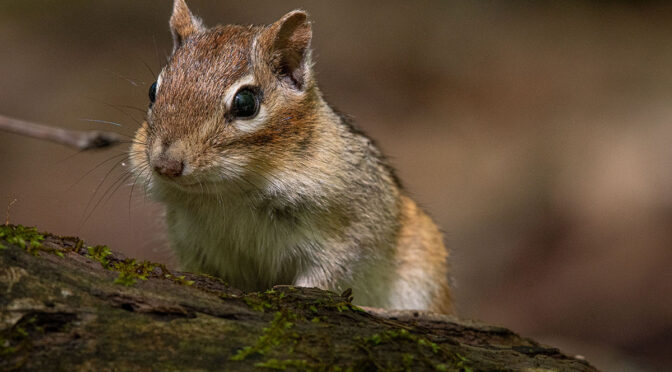
By the first day of April, Eastern chipmunks were out and about in large numbers, a red squirrel had set up a nest near the trailhead, the first butterfly of the season was seen, the Mourning Cloak(always the first!), and always seen in the few open areas in the park where the American chestnut trees were planted in the past, flying insects were becoming more numerous, many painted turtles were sunning themselves at both Muddy and Rocky Pond, and one Osprey was seen on its nest at Muddy Pond.
The second week of April found mostly sunny days with temperatures in the mid-60s. An Eastern phoebe was seen flying in and out of one of the abandoned quarry buildings on Crusher Rd. I could see its nest high up on an overhang near the ceiling. The same place it’s been making its nest for years. Numerous bluebirds also seen near the quarry. Hundreds of wood frogs croaking in the wetland area at the south end of Rocky Pond.
By the second week of April, trailing arbutus was flowering (always second after Coltsfoot), the Hermit Thrush had returned and Trout Lily leaves were beginning to emerge from the forest floor. On the 14th, yellow-bellied sapsucker was back and drumming, while on Muddy Pond, 2 Osprey were seen on and near their pole extension nest.
A day later a doe, and 2 yearlings accompanying her, were seen on Droopy Muffin trail. They would be seen numerous times in the following weeks. Two adult Canada Geese had set up nests on the west side islands on Muddy Pond. They obviously were sitting on eggs, because every time I checked the nests, they’d be sitting there, while their mate was nearby keeping strangers away.
On April 16th, I was surprised at how quiet the forest had become and I saw but a few birds including cardinal, tufted titmouse, white-breasted nuthatch, and Bluebirds flying in and out of the next they had recently occupied at the top of a dead white birch adjacent to quarry buildings.
During the third week of April, wood anemones were flowering, one of the Cooper’s Hawk was continually sitting low on its nest, very likely keeping its eggs warm, a brown creeper was seen bringing nesting material to its recently constructed nest, a solitary vireo was seen, and the bluebirds were seen flying continually in and out of their birch tree nest.
By the last week of April, trout lily were in flower, black-capped chickadees could be seen feeding on red pine seeds, belted kingfishers had returned to the ponds, bumblebees were out in large numbers, bellwort and sedges were in flower along with various violets, many bullfrogs and green frogs were calling at the ponds, and fiddleheads were opening,
During the first week of May, Dave Jenne, Shelley Lutz and myself went on a 5 hr. birdwalk and saw black-capped chickadees, crow, American goldfinch, tufted titmouse, downy woodpecker, cardinal, Carolina wren, white-breasted nuthatch, robin, brown creeper, American redstart, ovenbird, blue headed vireo, least flycatcher, northern flicker, Eastern phoebe, great crested flycatcher, field sparrow, hermit thrush, Eastern bluebird, hairy woodpecker, yellow-bellied woodpecker, black-throated green warbler, Eastern towhee, blue jay, black-throated blue warbler, red crossbill, black and white warbler, catbird, and white-throated sparrow. At Muddy Pond could be found many painted turtles sunning themselves, Canada geese nesting, and Common Mergansers. Catkins were hanging from the limbs of white birch trees.
During the second week of May, Moccasin flowers, Gay wings, star flowers, foam flower, butter and eggs, wood betony and pale corydalis were all blooming. Numerous reports of a sow and accompanying young bear seen at south side of park, adjacent to residential area. Female Cooper’s Hawk appears to be feeding young. Scarlet tanagers had returned, and after a rain, numerous red efts could be seen on the trails. Had to be careful where I put my foot. By this time of year, emerging tree leaves are making it harder to see birds higher up. Indigo buntings were back in numbers I have never seen before, red-wing blackbirds were nesting at Rocky Pond, ruby-throated hummingbirds were seen for the first time this season, and
Jack-In-The-Pulpit was blooming.
During the third week of May, I saw my first yellow warbler this season, while chestnut-sided warblers, red-eyed vireos, American redstart, black-and-white warbler, tufted titmouse, Eastern wood pewee, indigo buntings, northern cardinals, Carolina wren, veery, common yellowthroat, black-capped chickadee, least flycatcher, osprey and Canada geese were regularly heard or seen on just about every walk I went on in the park.
The last week of May I saw my first northern parula and cedar waxwing of the season.
Forget-me-not, Common buttercups, red clover, blackberries, fleabane, blue-eyed grass, and hawkweed were all blooming, and evergreen pollen was covering the perimeter of both Rocky and Muddy Ponds. The red admiral butterfly was seen under the power lines on the Carriage Trail, a place where I see them every year.
During early June, Field Cow Wheat, Tufted loosestrife, and Blue Flag were all flowering. And on June 7th, I replaced two dead American Chestnut trees with American Chestnut seedlings, and saw a beautiful Hummingbird Clearwing Moth. In Mid-June, the inevitable finally happened after 12 years of walking all around Pine Hill Park, observing the wildlife and planting trees and wildflowers-I was diagnosed with Lyme Disease. And it knocked me flat for at least two weeks. So, I’m ending my report here.
Hope you enjoyed this summary. Please remember to stay on the trails, and enjoy watching the Wildlife of Pine Hill Park.
by Tom Estill
We are so fortunate to have Tom checking on our wildlife through out the seasons and write up a great report for us.
During the week of the Winter Solstice of 2023, the forest was relatively quiet with Rocky Pond finally completely freezing over, though with thin ice, on Dec. 23rd. So quiet, that on that day of Dec.23rd, I didn’t hear or see a single bird on my walk to and from Rocky Pond, a very rare occurrence for me.
A few days later on a walk to Muddy Pond, I saw 4 flocks of about 12 Canada geese flying low towards Muddy Pond, white-breasted nuthatch, and black-capped chickadees.Both ponds were completely frozen over with thin ice, with the exception of a few small areas near the shores of both ponds Water was freely flowing into and out of Rocky Pond.
On Dec. 30th, David Jenne and Shelley Lutz participated in the annual Audubon Christmas Bird Count. The birds they saw and their numbers were:
Black-capped chickadees-23 White-breasted nuthatch-15 Tufted titmouse-8
Downy woodpecker-6 Canada geese-16 Dark-eyed junco-4 Raven-3
Crow-16
Hairy woodpecker-2 American goldfinch-2 Unidentified raptor-1 Pileated woodpecker-1 House sparrow-10 Cardinal-1
On Jan. 2, 2024, I saw a white-breasted nuthatch, downy woodpecker, pileated woodpecker and had the luck to be at the right place at the right time as I sat on the shore of Rocky Pond listening to 2 different flocks of wild turkeys calling back and forth to one another on opposite sides of the pond.
During those first few weeks of January, snow was starting to fall in appreciable amounts with a good dumping on the 20th, and bright sunny days, though rare, were so welcome. A small herd of deer could be regularly seen between trail markers 16 and 24, hairy woodpeckers were starting to be heard drumming back and forth to one another, tufted titmouse birds had changed their call to short, double “here, here” calls, and Carolina wrens were calling one another. On Jan. 22nd, I had the pleasure of hearing 2 pairs of Carolina wrens calling back and forth to one another over quite some distance. The Carolina wren seems to be a bird I am seeing more and more of as the years go by.
Feb. 5 was a gorgeous sunny day. Snow was mostly gone from the 3 lower Giorgetti trails, but still about 3” deep in the upper trails. The small stream feeding Rocky Pond was frozen over and the pond itself was covered in thick ice. Birds seen that day included cardinal,
white-breasted nuthatch, tufted titmouse, hairy and red-bellied woodpeckers. For the next week I saw pretty much the same birds along with pileated woodpeckers and black-capped chickadees.
On Feb. 11th, I was very surprised and delighted to see a Red Squirrel near the trailhead of the park. I see gray squirrels all the time, but rarely do I see a red squirrel. Since then, I’ve been seeing it on a regular basis in that same area, so I know it has a nest somewhere nearby.
By mid-February, gray squirrels were beginning to be seen along with yellow-crowned kinglets. There was one or two inches of snow on the ground. I collected a sample of debris from the bottom of one of the park streams, curious to see what might be alive in such icy cold streams. Through my microscope, I was able to observe a few ciliates, rotifers, a small annelid and a tiny Stonefly nymph.
The last week of February saw me regularly observing downy, hairy, pileated and red-bellied woodpeckers, tufted titmouse, white-breasted nuthatch, crow, brown creeper, and black-capped chickadees. The only open water observed was a small area surrounding the large beaver lodge on the east side of Muddy Pond, a few small spots of open water along the shores of Rocky pond, and the streams flowing into both ponds. Snow fleas(a sign for me that the worst part of winter is over) were seen on Feb. 21st, nuthatches and chickadees were chasing one another through the trees, hairy woodpeckers were drumming, and the lower trails were mostly bare ground.
On Feb. 25th, I observed a Cooper’s hawk flying near a Cooper’s hawk nest from last year, a barred owl near trail marker 16, where I see them every year, a rarely seen male red crossbill feeding on red pine seeds at Rocky Pond, and a black-capped chickadee feeding on both red and white pine seeds. While standing on the shore of Muddy Pond, I noticed a small area of open water in the distance, near where the main stream feeds into Muddy Pond. This seemed odd to me, in that the pond was pretty much completely covered in thick ice. As I approached the open area I could see the water churning. I assumed it was fish coming up to gulp air due to the decreasing amount of oxygen in the ice covered pond this time of year. To my surprise, it wasn’t fish gulping air, it was dozens of Eastern newts just coming out of hibernation, coming up for air.
On Feb. 26th, I was surprised to see a large flock of robins flying northward through the forest. Never seen, this time of year, such a huge, compact flock of robins like that before. Both Rocky and Muddy have numerous puddles on their surface, and at both ponds you could hear what sounded like distant thunder, moans and groans as the water was moving about beneath the
ice.
On March 3rd, I saw a very impressive huge flock of hundreds of grackles flying through the park. A day later, Canada geese, mallards and hooded mergansers were seen at Rocky Pond. By this time, Rocky was now mostly open water, with only the far east side covered in ice. At Muddy Pond, the only birds seen were one female and three male common mergansers.
March 6th was the first time I saw turkey vultures flying overhead near Rocky Pond, the first of the season. A few days later, both ponds were free of ice, Canada geese were seen on both ponds, many water insects could be seen in the shallows of Rocky Pond, along with many Eastern newts swimming about.
On March 11, 4 inches of snow covered the ground, but by the next day it was mostly gone.
By mid-March, oak tree buds were starting to open, and I couldn’t believe that I heard a few wood frogs calling at Muddy Pond. This time of year, the forest had also become surprisingly quiet. I thought southern migrants may have started to appear, but no such luck.
On March 17th, I spread hundreds of pitcher plant seeds along the shores of the Rocky Pond outlet in areas I felt would make ideal habitat for such plants. I was looking for areas similar to those found on the small islands on the west side of Muddy Pond which contain numerous pitcher plants.
On the last day of winter, I saw white-breasted nuthatch, tufted titmouse, carolina wren, cardinal, black-capped chickadee, hairy and red-bellied woodpecker, crow, and a few deer between trail markers 16 and 24.
That’s it for this issue. Please stay on the trails, and enjoy watching the wildlife of Pine Hill Park.
Updated: April 1, 2024:
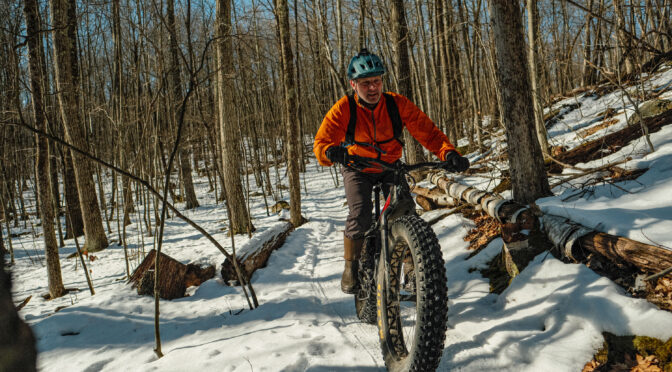
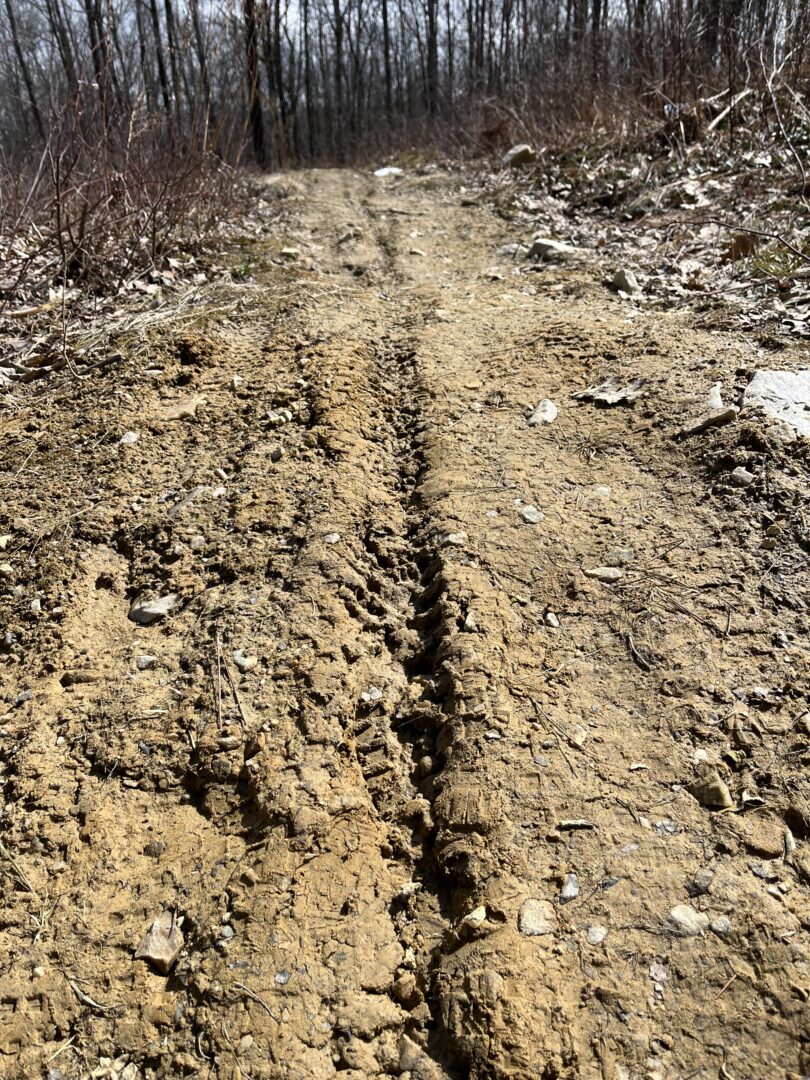
Trails are open. Please be smart when you ride. We have more significant snow in the forecast for mid-week.
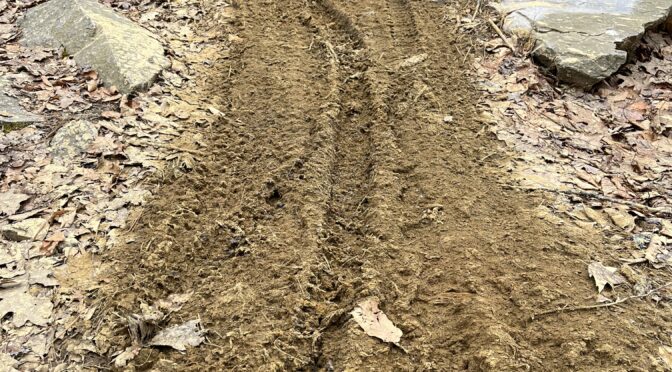
Don’t be this entitled mountain biker. This occurred after the 2 foot snowstorm on Saturday, March 23rd and March 30th. The rut in top picture had already been repaired.
IS IN THE BOOKS!
The Rutland Cold Rolled Fat bike Festival went off snow-or-no-snow—and as usual, was a HOOT!
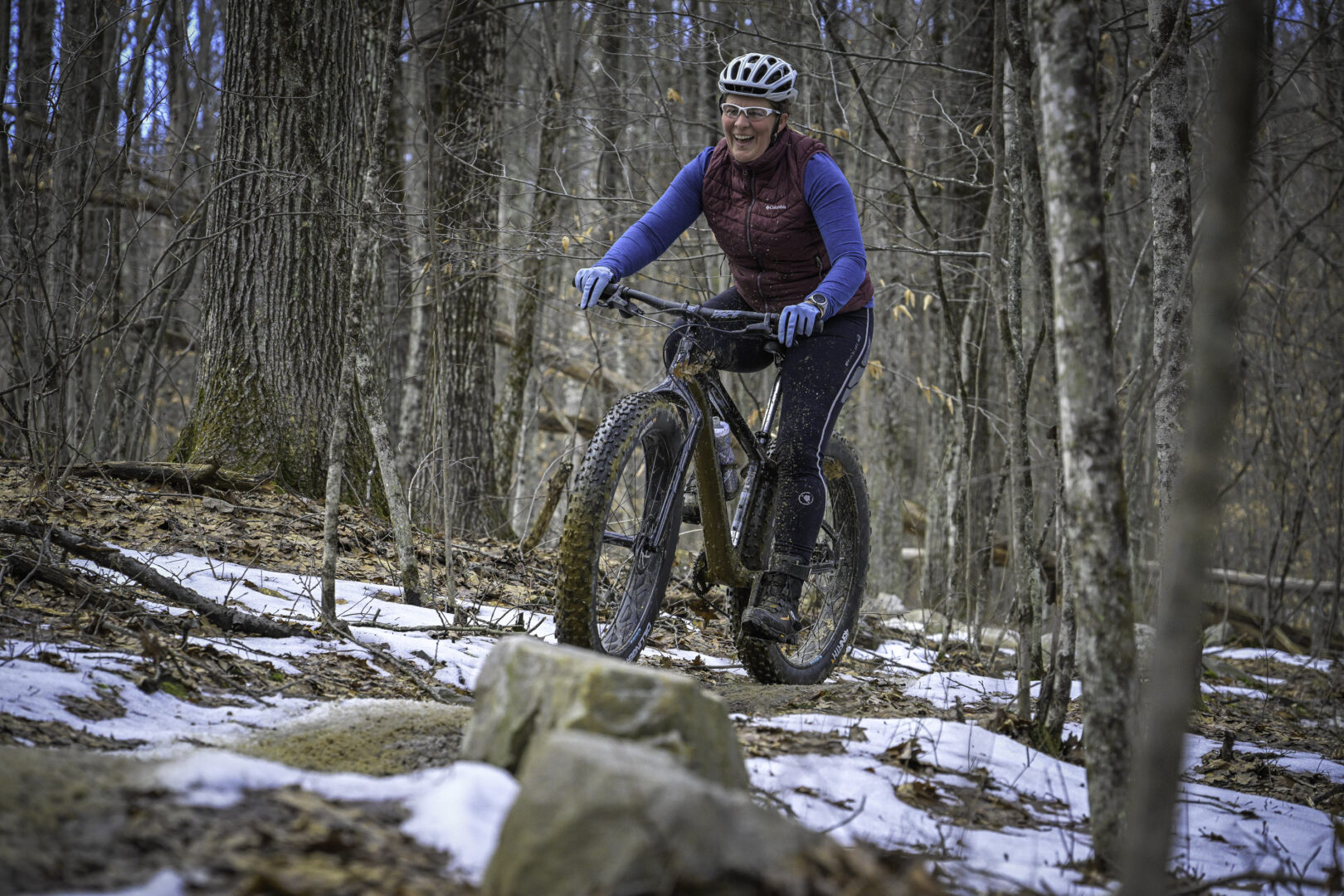
Cold Roll Rutland was a blast despite lack of snow for 2024.
The vendor village was full with cool stuff from Green Mountain bikes, Ranch Camp, Base Camp, Down Valley Bikes, Analog bikes, Porcupine bikes. Plus Appalachian Distillery from Middlebury came!
The aid station was at Rocky Pond which provided picturesque views to the north. Complete with Fiddlehead beer, snacks and Shelley’s chocolate peanut butter bars!


Despite the non-winter type weather folks had a good time. Yes, it would have been nice to ride on snow but for the most part trails were dry and in great shape.
More photos of the event can be found here.
Cold Roll for 2025 will be February 9th! Maybe we can conjure up some more winter type weather next year.
Autumn, 2023 Summary
By Tom Estill
The first day of fall found numerous birds flying throughout the forest including, cardinals, robins, broad-winged hawk, white-breasted nuthatch, blue jay, tufted titmouse, yellow-throated vireo, black-capped chickadee, hairy and pileated woodpeckers, yellow rumped warbler, and a few wood ducks and Canada geese at Muddy Pond. A dead short-tailed shrew was seen on the Carriage trail near Muddy Pond. First time I’ve seen that small mammal in the park. No obvious injuries, so was very curious about what might have happened to bring about its death. Sticktight, New England aster, flat-topped white aster and snakeroot were all in flower. Many chipmunks out and about.
On Sept. 25th, more species of birds were seen including red-eyed vireo, turkey vulture, blue jays, ravens, black-throated green warbler and Eastern Phoebe. Green frogs were a common sight at Rocky Pond, and a doe and 2 fawns were seen on Crusher Rd.
A few days later, many robins were seen migrating through the forest, which they always do this time of year.
This fall I was not surprised at the lack of acorns on the forest floor. We had a MAST two years ago, so we should have much more acorns next fall.
On the last day of Sept., I noticed numerous small chipmunks about the park. No doubt they were offspring of a second brood, something not unusual for chipmunks this time of year. Also saw both a chipmunk and solitary vireo feeding on red-osier dogwood berries near the trailhead.
Had a beautiful fall evening walk during the first week of October, seeing a white-throated sparrow and 2 young deer near trail marker 16A, an area of the park where I commonly see deer for reasons unknown to me.
By Oct. 8th, the forest was now very quiet with most migrants having passed through the area by now on their way south. Temperatures were noticeably cooler. The only bird I saw on my way to Muddy Pond was a white-breasted nuthatch. About 100 Canada geese were seen at Muddy Pond, along with 2 small flocks of Mallards and Wood ducks.
Park was at the height of fall foliage, but this year’s foliage season paled in comparison with most other years. Couldn’t help but wonder if this year’s spring hard frost and higher than normal precipitation had something to do with the lackluster foliage season.
During the third week of October, increasing numbers of robins were seen migrating through the forest and hundreds of Canada geese were seen resting at Muddy Pond.
Oct. 28th was a day of unusually warm temperatures, so I wasn’t too surprised when I saw a garter snake slithering among the leaves on the Carriage Trail. At the trailhead, robins could be
seen feeding on red-osier dogwood berries. Hadn’t realized so many different animals enjoyed eating those berries.
The first week of November found Muddy Pond covered with hundreds of migrating Canada geese and a lone Bald Eagle perched in a tree near the empty Osprey nest. I was able to collect hundreds of Button Bush seeds for planting along the shores of Rocky Pond next spring. Button Bush seeds are readily eaten by many waterfowl species. It’s hoped that by growing more Button Bush along the shores of Rocky Pond, more waterfowl may be enticed to spend more time at that pond.
On Nov. 11th, I had an interesting encounter with a small flock of black-capped chickadees. I was playing a recording of a barred owl when after a minute or two, a small flock of
black-capped chickadees that was flying about 20 ft. away, slowly made its way within just a few feet of where I was sitting. On Muddy Pond about 20 Canada geese, a pair of hooded mergansers, one common merganser, and a few mallards were observed. And at Trail Marker 16, another doe was seen.
A week later, a beautiful, healthy looking coyote was seen along the shore of Rocky Pond, and about 500 Canada geese were seen at Muddy Pond. A winter wren, dark-eyed juncos, and yellow-crowned kinglet were also seen.
During the third week of November, deer were again seen around Trail Marker 16, flocks of Canada geese were flying south overhead and Rocky Pond was finally completely frozen over. Most of Muddy Pond was also covered in ice, with the exception of a small area of open water around the large eastside beaver den. I was also surprised to see a few moths flying about.
During the first week of December, loose associations of birds could be seen, typically composed of black-capped chickadees, hairy woodpeckers, brown creepers, tufted titmouse, and white-breasted nuthatches. During a 3 hr. Walk, I observed such an association, one lone hairy woodpecker, and heard one crow, and that was all!
During the second week of December, it was still warm enough for water to be flowing into and out of Rocky Pond. Muddy Pond was frozen over except a small area in its center where you could see about 50 geese resting. On Rocky Pond, I found a pile of goose feathers spread about a small area. Some type of predator had captured and carried away a Canada goose.
In mid-December, I saw a barred owl, and a small herd of 6 deer near Trail Marker 16.
Both ponds were completely frozen over, a Cooper’s hawk was seen near the trailhead, and numerous does and a large 6 point buck were caught on my Trail Camera set up near Trail Marker 16.
On Dec.17th, a major storm was approaching the area and I saw only one animal, a crow, on my 2 hr. Hike.
On Dec. 19th, that same small herd of 6 deer was once again seen near Trail Marker 16. Near the trailhead I heard a gray squirrel making its continuous alarm call, and when I looked up, I saw a Cooper’s hawk perched in a nearby tree.
On the last day of fall, one-third of Rocky Pond was open water, and the rest of the pond was covered in a layer of ice thin enough to easily break through with my boot. The only animal I saw on my hike to Rocky Pond was a single white-breasted nuthatch.
That’s it for this report. Enjoy your time observing the natural wonders at Pine Hill Park, and please remember to stay on the trail and keep your pets leashed.
We are back in person in 2024!
Come join Pine Hill Partnership who is hosting our annual dinner to talk about up coming projects. We will have other organizations joining in the conversation to hear about what is happening in KMBC, WAMBA, SVT, GMT and ROC. Got all those acronyms???? Basically all the trail systems within less than an hour from Rutland.
We are holding on meeting Sunday, March 24th. At the Godnick Ctr, 1 Deer St, Rutland. Start time is 5pm with soup/chili being available for folks.
You do not need to be a current member of Pine Hill Partnership to attend.
Hope to see you there!
COLD ROLLED TIME!
Rutland Cold Rolled Fat bike Festival is back. Presented by Fiddlehead Brewing, and hosted by Mountain Bike Vermont and Pine Hill Partnership in Rutland, Vermont, Cold Rolled offers a day of fatbike stoke on cold-rolled single-track! Join us Sunday February 11th, 2024 as fat bikers from around New England and New York gather in Rutland to lead a charge with Old Man Winter, replete with group rides, demos, and hearty brews around warm fires.
Tickets here: https://www.eventbrite.com/e/rutland-cold-rolled-fatbike-fest-2024-tickets-775120214427?aff=ebdssbdestsearch
The event will feature a vendor village, rides for all ages and abilities, and groomed trails for your fat biking pleasure. Group rides will begin at 10am at the Giorgetti Athletic Complex at 2 Oak Street Extension (the Pine Hill Trailhead) where we’ll also convene for lunch at 12:00 pm. The remote aid station (aka party central) will be located at the overlook and will feature a bonfire and our favorite mid-ride refreshers. Lunch at Giorgetti will be catered by our friends at Ranch Camp (Stowe, VT).
“We’re beyond excited to bring the Cold Rolled back to Pine Hill – this trail network has some of the best fat biking in the state, and the community rallies to maintain them all winter.” says event co-founder & Killington Valley local Nate Freund of MTBVT. “We’re stoked to bring the party to Rutland and introduce riders from around the northeast to these amazing trails!”
The $50 ticket price ($35 for the under 21 crowd) includes group rides, lunch (with both carnivorous and veggie options), and a signed original Cold Roll Rutland artist print. So air down those tires, break out the extra layers, and get ready to party MTBVT style.
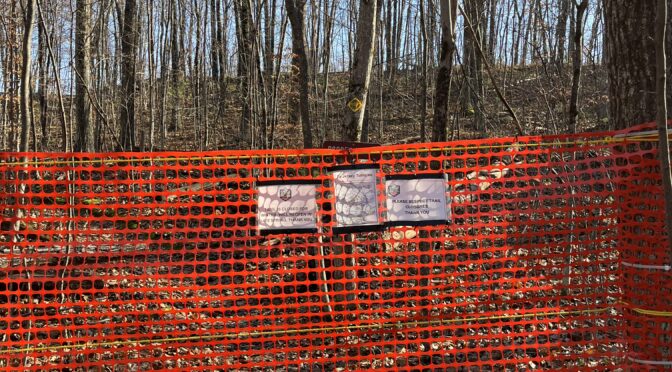
We have closed Exit Strategy, Droopy Muffin steep hill-between Intersection 30 and 30A and Lichen Rock. We have problems with freeze thaw cycles on these particular trails throughout the winter into early spring. Please respect closed trails. Thank you your hard working volunteers.
Tom Estill summer report is here! What a fantastic read too.
By the first official day of summer numerous birds are already successfully nesting in the park. For years now, the house wren continues to nest near the trailhead, either in one of the small birdhouses you see as you start your walk up to the trailhead, or in the birdhouse at the far end of the wooden walkway a short ways past the trailhead kiosk. I was sad to see an old dead beech tree, which for years had been used as a place for yellow-bellied sapsuckers to make their nests, had been blown over. For 7 years, the sapsuckers would drill a hole in a different spot on that dead tree. I always wondered if it was the offspring that was returning each year.
On this first day of summer, I saw the stunning scarlet tanager, always singing on Crusher Rd. near the old quarry, the American redstart, chestnut-sided warbler, ovenbird, red-eyed vireo and white-breasted nuthatch.
So, on June 24th, while walking in the forest, I thought it would be fun to compare life in the forest near the first day of summer, with life in the forest near the first day of winter. So, on June 24th, it was very hot and humid. Birds seen included house wren, red-eyed vireo,
white-breasted nuthatch, yellow-bellied sapsucker, American redstart, chestnut-sided warbler, common yellowthroat, song sparrow, ovenbird, Eastern pewee, veery, great crested flycatcher, blue jay, least flycatcher, hairy woodpecker, robin, Eastern towhee, hermit thrush, and Osprey on its Muddy Pond nest. Flowers blooming included white and red clover, ox-eye daisy, common buttercup, cow vetch, sheep laurel, blue flag, bedstraw, common fleabane, thimbleweed, yellow wood sorrel, multi-flora rose, yellow pond lily, fragrant water lily,
rough-fruited cinquefoil, and partridgeberry. And many chipmunks out and about. Now, on the first day of winter 2022, I saw black-capped chickadees, tufted titmouse, white-breasted nuthatch and crows, the ground was covered in a few inches of snow, both ponds were frozen over solid, and the temperature was near freezing. Wow!, quite a difference all around.
On June 25th, I came upon an adult doe on Middle Giorgetti trail which started walking towards me for some reason. I slowly backed away to leave it alone. Yellow bellied spasuckers were feeding their noisy young all throughout the forest, and I was disappointed to find out that the Cooper’s Hawk nest high in a white pine on Lower Giorgetti had been abandoned.
On June 29th, a garter snake was seen at Rocky Pond, a doe and fawn were seen at the same spot on Middle Giorgetti where I saw the doe on June 25th, bullfrogs, green frogs and schools of young bullheads were seen at Rocky Pond, and new flowers blooming included whorled loosestrife, bulrush, foxtail, bluegrass, button sedge, and St. Johnswort
On June 30th, I saw a few birds I don’t see often at Pine Hill Park, including the blue-headed warbler, a red-throated hummingbird feeding on milkweed nectar, and bluebirds at Rocky Pond. An Osprey was sitting on its Muddy Pond nest. Dragonflies were mating and laying eggs, and a
red fox was observed, all at Muddy Pond. Butterflies seen that day included the white cabbage and great spangled fritillary.
On July 3rd, a pair of barred owls were seen on Droopy Muffin, sapsucker chicks were chirping like crazy on a Svelte Tiger trail, and a doe kept following me near the old rock quarry on Crusher Rd., leading me to believe someone had been feeding that deer.
A week later, I saw a belted kingfisher, great blue heron and osprey on Muddy Pond. Bullfrogs could be heard, and many large bullfrog tadpoles were swimming near the shoreline. Indian Pipe was starting to flower and blueberries were starting to ripen. A milk snake was seen on the Carriage Trail. But the best news is that the spongy moth infestation had finally ended after 2 summers of deforestation by that insect. Hopefully, we won’t see that moth for another 10 years or so. The American Chestnut tree on Svelte Tiger did not recover from last years defoliation, but side shoots were observed growing from the side of the tree in a few spots.
On July 17th, I saw an unusually high number of robins flying through the forest. That behavior isn’t usually observed until the fall. Don’t know what that was all about.
By the last week of July, the forest had become so relatively quiet. For the most part, nesting season was over, and some birds had already started migrating south. One thing that I, and everybody else noticed about the forest this season was the unusual number of mosquitoes. The increased rain this year provided ample opportunities for mosquitoes to breed. In my 11
years hiking
Pine Hill Park , I have never seen so many mosquitoes. On one occasion, I
actually had a large swarm follow me on my walk. It was not a pleasant experience. And yes, I used bug spray
The last day of July, I was able to see one of my favorite flowers in the park-the small Pink flower. Usually overlooked by visitors and not very common, it can be seen on Crusher Rd., its color and petal markings are just striking.
The first week of August found the forest very quiet, with does accompanying fawns, blackberries ripe, lots of Chicken-of-the-Woods mushrooms, evening primrose in flower, a
ruby-throated hummingbird attracted to the red marker flag I was carrying, and a migrating Cape May Warbler flying through the forest. They’re one of the early spring migrants to arrive in the park, and one of the first to be seen leaving.
The first “feel” of approaching Fall occurred on Aug. 24th. The only bird I saw that day was the Eastern Pewee, and the only mammal I saw was a doe on the Carriage Trail. Forest once again very quiet. Flowers in bloom included the hog peanut, silver-rod, arrow-leaved tearthumb and knotweed. I planted a couple more wild American Chestnut seedlings on the edge of the Carriage Trail at Rocky Pond. Very soon a blight resistant tree will be released in the wild to pollinate wild American chestnuts, producing a Wild American Chestnut resistant to the blight, and the beginning of the comeback to our Eastern forests of that magnificent tree.
A spike horn buck following a doe was seen on Svelte Tiger trail on August 26th. Many chipmunks were scurrying about, Sulfur and Pearl Crescent butterflies were seen, and Calico aster, panicled hawkweed, closed bottle gentian, and toothed white-topped aster were all in bloom.
On Sept. 5th, a Belted Kingfisher was seen fishing at Rocky Pond, many green frogs and newts were seen in the pond, a tiny American Toad was seen on Crusher Rd., many young pickerel frogs were seen throughout the whole forest, and a Cottontail rabbit was seen near the trailhead. A cardinal, dark-eyed junco, and white-breasted nuthatch were the only birds seen.
On Sept. 19th, I was very surprised to see a woodchuck run into a hole under a rock at Rocky Pond. I’ve never seen a woodchuck so far away from the only other place I’ve regularly seen them in the park, and that’s on Crusher Rd. The only plants flowering were goldenrod, snakeroot, and a variety of asters. Great blue heron and small flock of wood ducks seen at Muddy Pond.
Had a beautiful hike through the forest on the last day of summer. Short-sleeve shirt temperatures, and mosquitoes not a bother. Many birds seen including, cardinal, robin, broad-winged hawk, white-breasted nuthatch, blue jay, tufted titmouse, yellow-throated vireo,
black-capped chickadee, hairy woodpecker, pileated woodpecker, yellow rumped warbler, and a few wood ducks and Canadian geese at Muddy Pond. Found a short-tailed shrew dead on the trail near Muddy Pond. It looked it perfect condition. Could not determine what may have caused its death. Sticktight, New England aster, flat-topped white aster, and snakeroot all in flower. Many chipmunks out and about.
That’s it for this edition. Please stay on the trails and enjoy your walks in the forest.